
When evaluating any artificial grass supplier in UAE, apply a four-point filter before discussing price: verify internationally recognized certification (FIFA Quality, ITF, or landscape-grade equivalents), confirm installation is carried out by their own trained crew, require a written material warranty of at least 10 years, and ask for documented after-sales support. Working through those four criteria practically eliminates underqualified suppliers before you request a single quote.
The UAE market has dozens of artificial turf dealers and installers, but the gap between a certified, full service contractor and a product-only reseller is significant. Hadir Projects & Environment Systems LLC (HPES) is a UAE-based sports and leisure construction specialist with a broad regional portfolio spanning school campuses, government sports facilities, private clubs, and commercial developments. This guide walks you through every criterion, in order of importance, so you can shortlist confidently and avoid costly mistakes.
The price per square metre is the number most buyers ask for first. It should be the last figure you lock down. An uncertified supplier selling cheap turf without international compliance documentation can cost you far more in premature replacement, failed inspections, and liability than any upfront saving.
FIFA Quality and FIFA Quality Pro are the two recognized tiers for football-grade artificial turf. A supplier holding certified product has passed laboratory performance tests covering ball rebound, shock absorption, rotational resistance, and drainage. These are verified results, not marketing claims. For any pitch that will host competitive matches or operate under a school or club license, FIFA certification is essential. Ask for the certificate number and verify it directly on FIFA’s public register.
Beyond FIFA, the relevant standards are WA (formerly IAAF) for athletic tracks, ITF for tennis, WR for rugby, and FIBA for indoor courts. For landscape and residential turf, these governing body marks do not apply directly, but ask for documented UV-resistance testing, drainage performance data, and relevant European product safety certifications such as EN 15330 for synthetic sports surfaces. A supplier who cannot produce test documentation for the specific product being quoted is one to remove from your shortlist.
Screen any potential fake grass supplier UAE quickly with three requests: a copy of the product’s certification or test report, a portfolio of completed projects with client references, and proof that the installing crew is factory-trained or product-certified. If any of these is delayed, unavailable, or vague, treat it as a disqualifying signal at the evaluation stage rather than a problem to resolve after signing.
Specifications drive performance. Requesting a sample without knowing what the backing, yarn type, pile height, and drainage rate should be is like test-driving a car without knowing your road conditions. The UAE’s climate is defined by intense UV, high surface temperatures, and occasional sand and salt exposure; not every imported turf product meets the performance thresholds these conditions demand.
For outdoor UAE installations, request UV-stabilized polyethylene (PE) monofilament yarn with a documented UV warranty of at least 7 to 10 years. Drainage performance should be stated in litres per square metre per minute; published specifications from suppliers and governing bodies commonly range from 20 to 60 L/m²/min, so treat 20 L/m²/min as a practical baseline and always request the supplier’s independent test data rather than accepting a single figure as universal. Backing should be polyurethane
(PU) or a multi-layer equivalent, not basic latex, because PU backing performs better through repeated heat cycles. Any synthetic grass supplier Dubai or broader UAE-based that cannot provide these numbers in writing is selling on appearance, not performance.
For standard residential landscaping and villa gardens in the UAE, a pile height of 30 to 40 mm with a minimum yarn strength of around 11,000 dtex is appropriate. High-traffic commercial areas should target 14,000-plus dtex with a shorter pile height of 20 to 30 mm for easier maintenance. Sports applications require application-specific selection: football turf typically runs 40 to 65 mm with a shockpad underneath, while padel and tennis require very different yarn constructions. A supplier who recommends one grade for all uses does not have the product depth your project needs.
Product quality means nothing if installation is poor. Turf that lifts at seams or shifts under traffic is nearly always an installation failure rather than a product failure. The most reliable way to evaluate any artificial grass supplier in UAE is to look past the showroom samples and examine their site processes directly.
A proper supply-and-install contract in the UAE covers site survey and sub-base assessment, ground excavation or preparation where required, installation of a permeable membrane and drainage layer, cutting and seaming of turf rolls, infill application for sports or high-traffic turf, edge securing, and a post installation inspection.
Ask directly: does the supplier install with their own employed crew, or do they subcontract to third parties? Owner-installed projects give you a single point of accountability for both product and workmanship. Subcontracted installation creates a gap where warranty disputes can fall between two parties. Also confirm whether site supervision is provided by a qualified project manager throughout the installation, not just at handover.
Warranty language is where the gap between a premium supplier and a budget one becomes legally visible. A well-worded warranty tells you exactly what is covered, for how long, under what use conditions, and who is responsible for repair or replacement. A common clause buyers overlook is whether the warranty covers UV fading only beyond a stated threshold, or whether it covers structural fiber breakdown and backing delamination as separate triggers.
Quality artificial turf in the UAE carries a manufacturer warranty of 8 to 15 years on the turf material, covering UV-related fading beyond stated thresholds, fiber breakdown, tuft-bind failures, and backing delamination. Installer workmanship coverage is a separate document and typically runs 1 to 3 years, covering seams, drainage, edging, and base performance. Both documents should be provided at
handover. A supplier who bundles both into one vague “10-year warranty” without specifying what is material-covered versus installation-covered is offering a document that may be difficult to enforce.
Because UAE installations face conditions that European warranty templates were not written for, request written confirmation that the warranty is valid for the local climate and the stated installation method. Surface temperatures on artificial turf can reach well above ambient air temperatures depending on pile color, infill type, and sun exposure; ask specifically for heat-resistance test data covering the product being quoted. The document should also specify acceptable UV fading thresholds, whether reflected sunlight from adjacent buildings creates an exclusion, and what maintenance obligations you must meet to keep the warranty active. A 15-year warranty is not a guaranteed 15-year lifespan; actual service life for well-maintained residential turf in the UAE commonly runs 12 to 20 years, while commercial or high-traffic surfaces typically last 5 to 12 years.
After-sales support is the part of the supplier relationship that most buyers only think about after something has gone wrong. In the UAE, where turf surfaces experience extreme heat, sand infiltration, and heavy use during cooler months, a clear after-sales framework is as important as the installation warranty itself.
A credible artificial turf supplier in UAE offers:
Periodic maintenance visits covering brushing, infill top-up, and seam inspection A documented response process for warranty claims
Access to matching infill and repair turf from the same production batch
A named contact rather than a general enquiries inbox
For sports facilities and school campuses especially, ask whether the supplier provides post-installation performance testing, confirming that drainage, shock absorption, and surface friction still meet governing body specifications after the first season of use.
One of the most reliable pre-contract tests is to contact the supplier’s existing clients directly. Ask how quickly the supplier responded to a post-installation issue, whether infill replenishment was available, and whether the project manager who oversaw installation remained accessible during the maintenance period. An established astro turf Dubai or UAE-based operator with a documented project portfolio will have verifiable references; a newer or less-established one will struggle to provide them.
All five criteria above converge in the same place: a supplier with genuine international certification, documented project depth, in-house installation teams, clear warranty terms, and a structured after-sales programme. In the UAE market, that profile is less common than the number of businesses advertising “artificial grass installation” would suggest.
HPES delivers the full scope: design consultation, supply of FIFA-certified and internationally compliant turf, in-house installation across sports and leisure applications, and post-handover support, backed by a track record built over a quarter-century and more than 2,000 regional completions. Their project portfolio spans school campuses, government sports facilities, private clubs, and commercial developments, which means the specification process is informed by actual operational experience across use types and climates. For a buyer evaluating multiple artificial turf suppliers in the UAE, the HPES model of end-to-end delivery is a useful benchmark against which other shortlisted suppliers can be measured.
When you contact any supplier, provide a clear project brief upfront: the surface area in square metres, the intended use (residential garden, football pitch, school play area, or commercial landscape), the timeline, and any governing body compliance requirements. Request a product sample alongside the full technical data sheet. Compare written warranty terms side by side across shortlisted suppliers before price becomes a deciding factor. The supplier who answers your specification questions clearly, promptly, and in writing is almost always the one whose installation will go smoothly.
The right artificial grass supplier in UAE earns shortlist status through certification first and price last. Work through the five criteria in this guide, credentials, product specs, installation process, warranty terms, and post-completion support, in that order, and the shortlist practically assembles itself.
The UAE market rewards buyers who ask specific, documented questions. Suppliers who answer in writing, back their answers with verifiable project references, and bring full-service capability from design to handover consistently outperform those who lead only on price.
If your project needs a certified, experienced, and regionally proven artificial turf partner, get in touch with the HPES team and ask them to walk you through projects similar to yours. Bring your site area, intended use, and compliance requirements to that first conversation, and you will leave with a specification-level understanding of exactly what your project needs.

Many UAE facility owners fall into the same five traps before a single tile is laid: ignoring climate, mismatching materials...
Know More
When searching for artificial grass supplier in UAE, verify quality certifications first. Confirm FIFA compliance where required, request a full...
Know More
When evaluating any artificial grass supplier in UAE, apply a four-point filter before discussing price: verify internationally recognized certification (FIFA...
Know More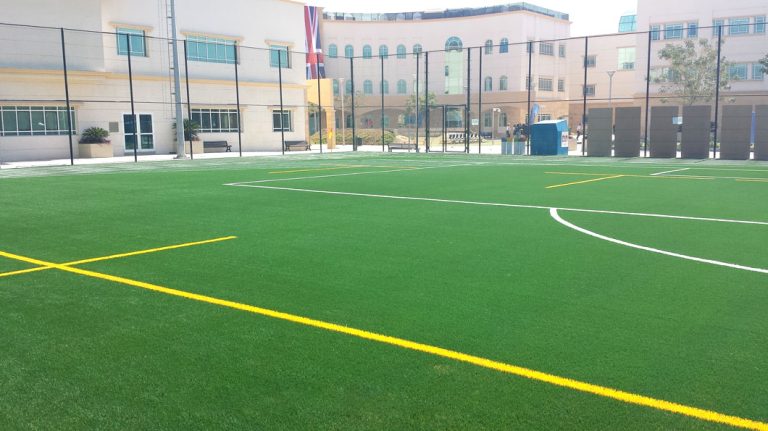
The UAE artificial turf market is crowded, and many buyers don’t discover they chose the wrong supplier until the surface...
Know More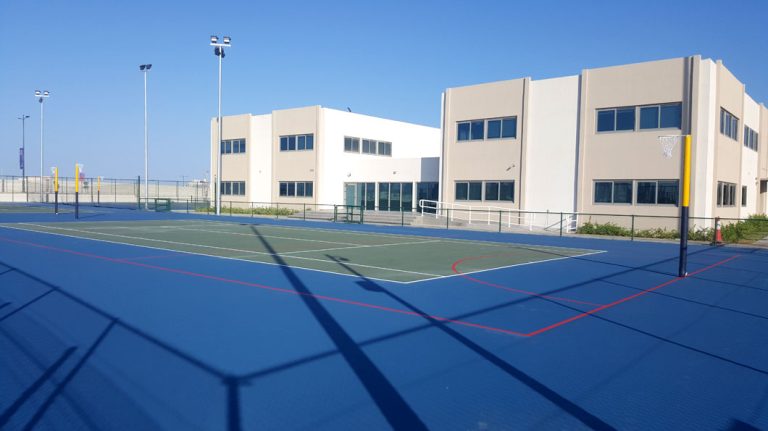
No wonder innovation has taken over every aspect of life, and sports infrastructure is no longer an exception. In recent...
Know More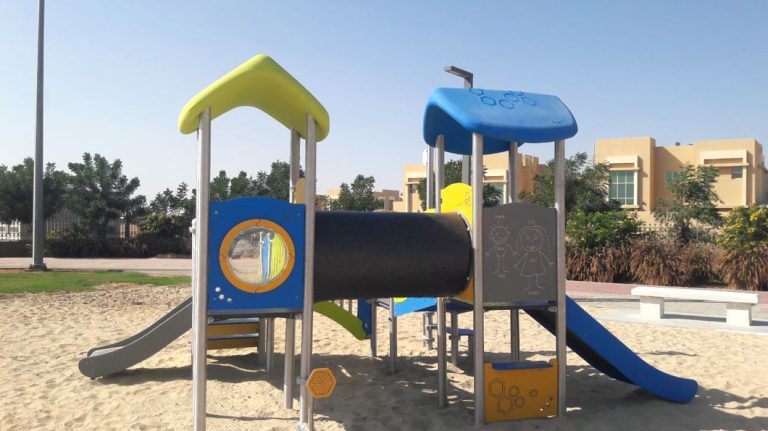
In the UAE, children’s playgrounds are far more than recreational add-ons; today, they are a prime lifestyle amenity that directly...
Know More
